

Behavior Strategies and Tips
Welcome to our monthly behavior tips and strategies page. We hope you find these helpful in your life as a parent and/or professional! Scroll down to see the ones you may have missed!

May 2026
The “Green-Yellow-Red" Relationship Check
A practical approach that encourages better, healthier relationship decision-making. Healthy relationships aren't necessarily obvious or intuitive; it takes practice to develop.
This tool helps individuals (and teams) move beyond rules and into real-time awareness, consent, and choice.
GREEN: Safe, Consensual, and Respected
How it feels:
Comfortable, calm, relaxed, or happily enthusiastic
Free to be yourself
Both your "yes" and "no" are respected
How it looks:
Obtaining consent (i.e., "May I give you a hug?")
Mutually interested in one another (i.e., want to spend time together)
Clear and kind communication
Respect for boundaries
Teaching/Discussion Questions:
What makes you feel comfortable and safe in this relationship?
How do you know that they respect you?
Skill Focus:
Safety awareness, expressing preferences, and consent practice
YELLOW: Pause, Check-In, Get Curious
How it feels:
Unsure, confused, pressured, or rushed
A sense that something doesn’t seem right, even if you’re not sure why
Contradictory information
How it looks:
One person wanting more than the other
Persistent texts/calls with no response
Testing limits or pushing boundaries “just a little”
Progressing too fast, whether emotionally or physically
Teaching/Discussion Questions:
Let’s stop and take note of what your body is communicating.
Do you feel you have a real choice in this situation?
What would help you feel more comfortable?
Skill Focus:
Interoception (body awareness), slowing down, seeking assistance, and re-establishing boundaries
RED: Dangerous, Nonconsensual, or Damaging
How it feels:
Scared, intimidated, overwhelmed, or shut down
Feeling that you cannot say no or that your "no" doesn't matter
Frozen, confused, or “stuck.”
How it looks:
Not respecting boundaries, such as ignore when you saying no
Using guilt, manipulation, or threats
An unequal power dynamic (authority, coercion)
Being told to keep secrets and not tell others what is happening
Any form of abuse or exploitation (Sexual, physical, verbal, or emotional)
Direct statements to support:
Let’s get to a safer space together.
You don’t have to stay in this situation.
I’m here with you, we can leave.
Teaching/Discussion Questions:
What was your body feeling during this event?
When did things begin to not feel okay or safe?
What would you want to see happen differently?
How can we make you feel more secure the next time?
Skill Focus:
Safety planning, seeking help, recognizing coercion, and rights awareness
Using This Resource in Real-Life Scenarios
1. Teach when calm (not during crisis)
Use real-life experiences or pretend play:
What zone would this experience fall under? Green, Yellow, or Red?
"Would something turn yellow to green?"
2. Use in the Moment
During any experience:
"How are you feeling right now: Green, Yellow, or Red?"
"How can we make this situation safer for you?"
3. Connect it with Body awareness skills
Link feelings with bodily reactions
Tense Chest = may fall under yellow zone
Relaxed Body = most likely to be green zone
Frozen/Shut Down = could be a red zone
4. Normalize All Zones
Green = safe
Yellow = learning and awareness (not “bad”)
Red = needs support, not punishment
Relationships can move between green, yellow, and red, and that’s important to notice.
Important Reminder for Teams
This tool is not about controlling relationships. It is about developing the capacity to make decisions safely and independently.
Individuals with IDD have a right to:
Relationships
Sexual expression
To make mistakes and learn from them
What we do is:
Support and build awareness
Encourage safety
Protect and preserve dignity
Promote choice and dignity of risk
Support Team Self Check-In
Am I supporting autonomy, or controlling outcomes?
Am I reacting, or responding intentionally?
Am I helping build skills, or just stopping behavior?
Apr. 2026
The Curiosity Pause
When a challenging moment arises, our natural instinct is often to react quickly: to correct, redirect, or stop the behavior. While safety should always remain the priority, one of the most powerful support strategies is something simple: pausing with curiosity before responding.
The Curiosity Pause invites support staff, families, and team members to take a brief moment to reflect on what might be happening beneath the behavior. Behaviors are not simply “problems to fix,” but forms of communication about needs, stress, confusion, sensory overload, or unmet connection.
During a Curiosity Pause, ask yourself a few simple questions:
What might this person be experiencing right now?
What happened just before this moment?
What need might be underneath this behavior?
How can I respond in a way that supports safety and dignity?
Approaching situations with curiosity helps shift the focus from control to understanding. When individuals feel seen, heard, and supported rather than judged or rushed, it often reduces escalation and opens the door for learning and skill-building.
Over time, practicing the Curiosity Pause helps teams identify patterns, adjust environments, and build proactive supports that better meet each person’s needs.
Sometimes the most meaningful change begins with something small: a moment of pause, a shift in perspective, and a willingness to understand before reacting.
Mar. 2026
Name It Before You Redirect It
When behaviors show up around gender expression, relationships, boundaries, or sexuality, the instinct is often to correct immediately. While well-intended, quick redirection can unintentionally create shame, confusion, or escalation.
The “Name It Before You Redirect It” strategy shifts the focus from control to understanding.
Before redirecting a behavior, staff first name what the behavior is communicating (such as identity, expression, attraction, or body curiosity) using neutral, affirming language. This helps individuals feel seen and understood, which supports regulation and learning.
For example:
“This looks like you’re exploring how you express yourself.”
“It sounds like you’re feeling attraction and wanting connection.”
“These seem like questions about your body.”
Once the need is named and validated, staff then clarify expectations around time, place, consent, and privacy, and redirect to a safer or more appropriate option.
When people feel understood first, they are more open to guidance.
Understanding leads to regulation, and regulation leads to safer behavior.
Feb. 2026
Repair Script
Repair Is a Skill, Not a Consequence
When harm, rupture, or escalation happens, repair is one of the most powerful behavior supports we have. For individuals with ID/DD, repair builds safety, restores trust, and reduces future distress far more effectively than punishment or control.
This month, we’re highlighting a simple Repair Script that guides supporters to:
Pause and regulate first
Take ownership without excuses
Name the impact, not just the intent
Validate feelings
Offer repair and commit to change
Check back in to ensure trust is restored
Repair teaches accountability and connection, showing that relationships can survive mistakes. When people feel safe after things go wrong, challenging behavior decreases and trust grows.
Repair doesn’t undo harm, it transforms it into learning and belonging.
Jan. 2026
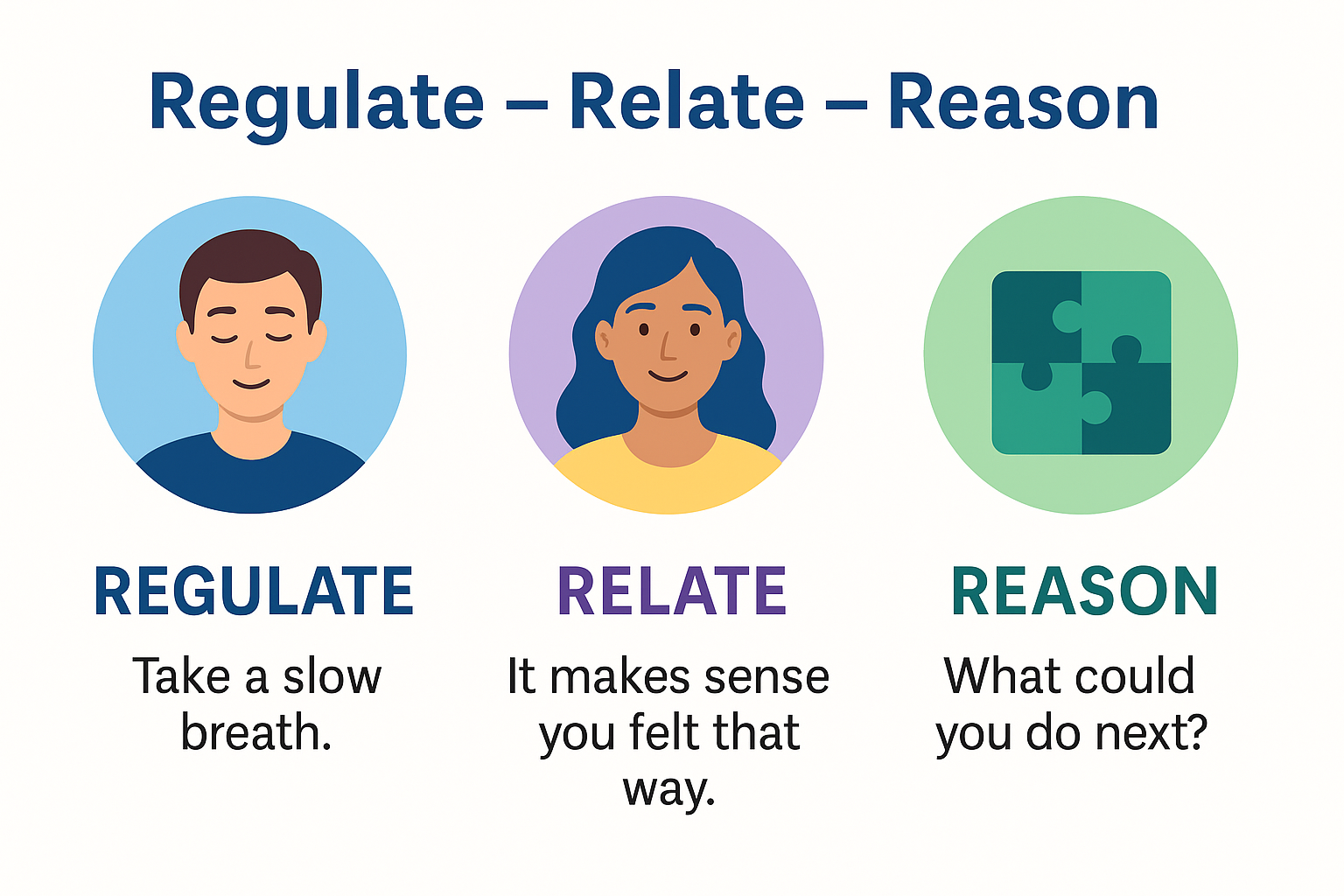
The “Regulate → Relate → Reason” Approach
What if challenging moments were invitations to regulate, relate, and then reason? Thus, resulting in building skills instead of power struggles.
Many individuals with IDD experience big emotions and lagging executive-functioning skills that make traditional behavioral correction ineffective. A trauma-responsive, brain-based sequence helps staff respond in ways that build skills rather than escalate situations:
Regulate → Relate → Reason
Regulate: Support the nervous system first. Offer calm tone, space, sensory tools, grounding.
Relate: Connect through shared humanity. Validate feelings, match energy calmly, show you’re on their team.
Reason: Only after safety and connection, introduce problem-solving, reteaching, or alternative skills.
This sequence reduces defensive responses and strengthens long-term self-regulation, essential for individuals with IDD navigating complex environments.